This article contains affiliate links.
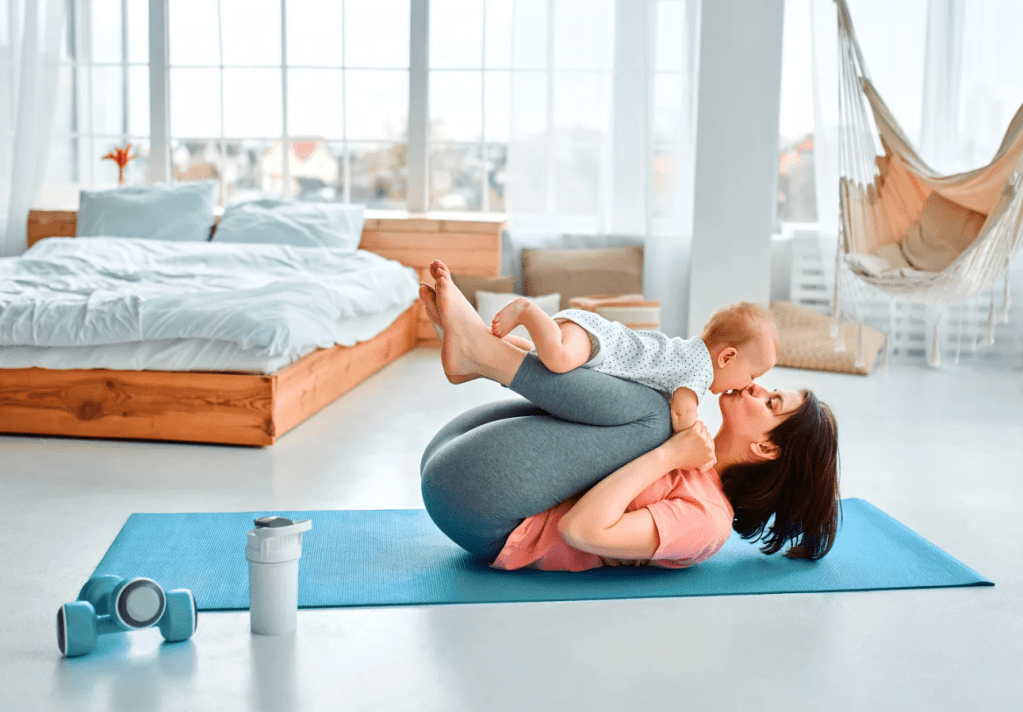
I don’t know about you, Mama, but when I was in my postpartum days and wanted to get back into my movement routine, leaving the house (outside of a stroller walk or grocery trips) to go to a gym felt impossible. However, I was determined to build back my strength and endurance and wouldn’t let my limited time and space stop me. With a little creativity (and some smart gear choices), you can build a powerful, functional home gym that fits your space, your schedule, and your budget. Whether you’re chasing toddlers or goals, a home setup can make fitness more realistic and enjoyable.
To help you get started, here’s a breakdown of budget-friendly home gym essentials organized by function—from strength training and mobility to cardio and recovery. These tools are budget-friendly, space-saving, and mom-life approved.
Strength & Resistance Training

- Dumbbells: You can go with adjustable or fixed dumbbells. Starting with 3–15 lb should work well, depending on your fitness level. Fixed weights are budget-friendly, easy to find secondhand, and great for beginners. Adjustable weights cost more upfront, but they replace multiple sets, saving space and money in the long run as you increase your strength over time.
- This adjustable dumbbell set is a great option for a lighter weight range. However, if you want to lift heavier, this adjustable dumbbell set goes up to 25 lbs.
- These hex-shaped dumbbells are a great option for the traditional feel and look. However, if you’d like a softer material to grip, these non-slip dumbbells are a great option.
- Resistance Bands: These come in a variety of resistance and thickness levels. I found loop and fabric, elastic bands to be good for strength training.
- I’ve always loved these Defining Booty Bands by Barre Definition. They come in a 3-pack for resistance levels light, medium, and heavy. They’re stretchy, but strong (and cute too)!
- If you like thicker resistance bands (great for glute workouts), this pack of fabric elastic bands comes in 4 resistance levels and will challenge you during those booty workouts!
- Wrist & Ankle Weights: Great for adding resistance to glute, upper body, and core work. I enjoy wrapping them around my ankles and wrists when doing barre or HIIT workouts at home. Plus, you can wear them on walks to get more from your movement. These weighted bangles are an affordable and stylish option!
- Weighted Body Bar: Friendly for small spaces, weighted body bars are versatile and safe option for home use if you don’t have space for a barbell (not to mention, more affordable). These are a great option for beginners and if your goal is to build foundational strength by adding weight to standard exercises (like squats and lunges). You can buy them as a set, or single bars.
- This weighted bar set comes in a set of 5, 10, 15, and 20 lbs. if you’d like a range of weight options as you increase strength.
- However, a single weighted bar is a budget-friendly, space-saving option that’s versatile enough for strength, cardio, and core workouts.
- Kettlebell: These can be a budget-friendly staple in your home gym, especially if you stick to just one or two well-chosen weights. They’re incredibly versatile—you can use them for strength, cardio, and full-body workouts—all in one tool. If you’re really pressed for space, a single kettlebell can replace multiple dumbbells for compound moves like swings, squats, and presses. However, like all workout equipment, it’s important to learn proper form when using kettlebells (I say this because while many may be more comfortable using dumbbells, there can be a bit of a learning curve for kettlebells).
- This adjustable kettlebell ranges from 5-12 lbs. and is a great budget-friendly option for your home gym. You essentially get three kettlebells in one, and the weight range is good for beginners.
- These individual, soft kettlebells are a safer option for an indoor home gym because their base is soft. Meaning, they are built to be safer for your floors. Generally, individual kettlebells are a better option if your workouts are pressed for time (which let’s face it…most of us moms need to make the most of our time) because you don’t need to adjust the weights.
Mobility, Recovery, & Core

- Yoga Mat: A staple in any home gym. Yoga mats are the foundation of your workouts since they keep you grounded as you move. They’re great for a variety of home workout types–yoga, barre, HIIT, tabata, strength training, and more. The thickness level of your yoga mat matters. For example, a thicker mat is best for joint comfort, especially on tile/hard floors. Yet a thinner mat is better for stability and balance during your workout; they’re easier to carry and store, and they tend to be durable for dynamic movement (think less “squish,” so it holds up well during bodyweight exercises, core work, or fast-paced routines).
- Thin yoga mats like Manduka’s eKO Superlite Yoga Mat are a good option if you want a lightweight, thin mat that you can take with you anywhere. It’s 1.5mm, so storage and travel are a cinch!
- Gaiam’s 5mm Yoga Mat can be considered the sweet spot when it comes to mat thickness. It’s a non-slip mat that’s right in the middle for thickness, while supporting balance and stability during movements. It’s also a more budget-friendly option!
- This ⅖ inch extra thick yoga mat supports your joints during those floor workouts and has an anti-slip design. This is a good option if your joints need more support.
- Foam Rollers: Every active mama needs a foam roller in their home! My foam roller is a staple for muscle rehab after workouts (especially for those high-impact sessions). Foam rolling targets the fascia—the connective tissue around muscles—breaking up tightness or knots that may cause pain and stiffness. They also help improve blood flow and reduce muscle soreness.
- This small, multi-density foam roller is a great option for travel, and works as a space-saver.
- Gaiam’s Foam Roller is a longer option–offering better stability and coverage. Longer foam rollers are ideal for full-body rolling, spine alignment work, and beginners needing more control.
- A textured foam roller may be a bit more expensive, but they can provide deeper, targeted pressure—great for intense soreness or tight spots that need extra attention.
- Sliders: A truly budget-friendly home gym staple that will make your abs put in work! Sliders (or Sliding Discs) look simple, but don’t underestimate them. They engage and strengthen your core. Many are dual-sided to be friendly for a variet of home surfaces.
- These core sliding discs are dual-sided and budget-friendly.
- Yoga Straps: A low-key addition to your home gym that can help improve flexibility, deepen stretches, and support proper alignment. Yoga straps make it easier to safely reach and hold poses, especially for tight hips, hamstrings, or shoulders. I love using mine for the cross-arm stretch and Supta Padangusthasana 1, 2, and 3 (a.k.a. Reclined Hand to Big Toe Pose).
- The Original Stretch Out Strap is my favorite strap that I’ve used for years. I like that there are loops that make it easy to adjust the depth of the stretch while maintaining a good grip.
Cardio & Movement

- Jump Rope: Jump Ropes are an affordable, small-space-friendly, and effective home gym staple for cardio workouts and warmups (just watch out for your surroundings while jumping mama). I use my jump rope for warmups because they increase my heart rate quickly, warm up major muscle groups, and loosen my joints.
- This tangle-free speed jumping rope has ergonomic handles, a good grip, and is durable. I got a two-pack (both me and my husband use them), and they’ve lasted us a long time.
- Mini Stepper or Aerobic Step: Aerobics is a beneficial form of cardio exercise that can be easily done at home. Adding an aerobic step or mini stepper is a low-impact, space-saving cardio tool that will spice up your aerobic workout session. Plus, you can use these with your littles during playtime too (they can be a useful PT and OT tool for toddlers and kids).
- This aerobic exercise step platform is and affordable option. It’s adjustable and has a self-storage design for those small spaces.
- This high-step aerobic platform gives more of a challenge during your workout with additional height options.
Building a functional home gym in limited space and with a budget is possible. What I suggest is to start with a yoga mat because it’s a foundational piece for stability and support, and it’s versatile in the types of workouts that can be carried out on it. After that, select your workout focus and make sure it’s what you enjoy. Working out should be fun, so whether you want to gain muscle or work that heartrate with cardio, pick a starting point with your gear. Then, get items at your budget-friendly pace. This avoids overwhelm and gets you moving your gear of choice.

 Glow and Hustle
Leave a comment